Ep 5: The Sunk Cost Fallacy of Staying Put: What a Failed Paper Science Course Taught Me About Life Design
Key Takeaways (TL;DR)
The Sunk Cost Fallacy causes professionals to stay in misaligned roles simply because they’ve already invested time, money, or effort.
Calculated Friction: Short-term discomfort (like drop fees or tough conversations) is exponentially cheaper than long-term energetic bankruptcy.
System Signals Matter: Hesitation and dread aren't always laziness; they are often accurate diagnostic data that a system is out of alignment.
Optimization Strategy: Pivoting isn't quitting; it's re-allocating capital (time, mental energy, attention) to high-yield opportunities.
The Unexpected Elective: When Insecurity Drives the Decision Matrix
Back in my junior year of mechanical engineering, my peers were starting to find their distinct technical tracks. Some were diving deep into robotics and automation, others into advanced manufacturing or fluid mechanics.
When I looked at my own path, I felt an uncomfortable blank space: I had no idea what direction I wanted to take.
In an effort to find solid ground, my brain did what many overthinking, analytical minds do: it scanned the past for historical data. As a kid, I loved paper. I wrote letters, saved greeting cards, and made digital graphics. So, when a "Paper Science" course popped up on the elective list, my logic compiled a hasty conclusion: I like paper, I'm an engineer, therefore I should take Paper Science.
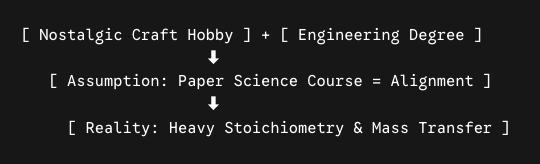
What I failed to do was run a preliminary system diagnostic—I didn't talk to anyone about what the course actually entailed.
The Anatomy of a Sunk Cost (Bikes, Books, and Atomic Formulas)
It didn't take long for the system to throw error codes.
Picture this: I am notoriously bad at riding a bicycle, but I bought a bike specifically to haul myself up a steep campus hill to a remote auditorium on the edge of campus. I sat down in uncomfortable movie-theater seating, opened the textbook, and realized within ten minutes that I was completely out of my element.
This wasn't mechanical design. It was heavy chemical engineering—mass transfers, stoichiometry, and complex atomic formulas.
Within two weeks, my gut signal was clear: Drop the class.
Yet, I stayed for an entire semester. Why? Because I was trapped in the Sunk Cost Fallacy.
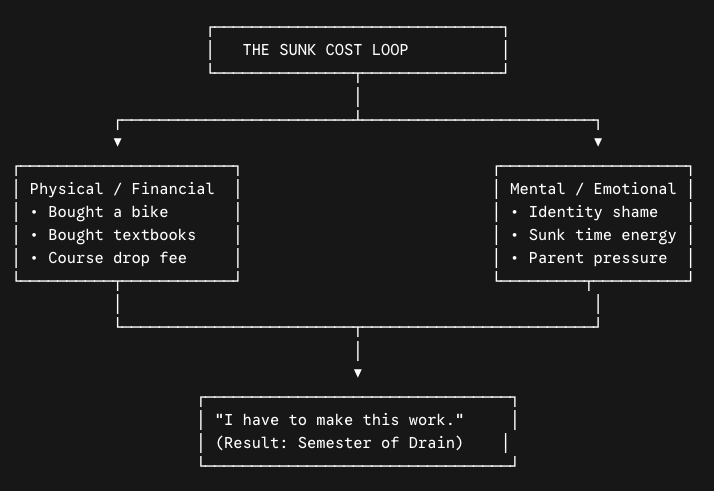
I had already bought the bike. I had bought the books. Dropping the class meant paying an out-of-state administrative drop fee. It meant calling my mom—who was literally making massive sacrifices to establish state residency to reduce my tuition—and admitting I picked the wrong class.
My stubbornness and shame took over. I leaned on an exceedingly patient chemical engineer friend to survive every single homework assignment and pass. I forced the outcome through sheer willpower.
Financial Friction vs. Energetic Bankruptcy
Looking back through a Design lens, forced endurance is rarely a victory.
Yes, I passed. But the resource allocation was entirely inefficient. I spent months learning basic chemical engineering formulas I would never use, dragging my energy through constant dread, when I could have cut my losses in week two.
If I had swallowed my pride, absorbed the minor administrative drop fee, and communicated transparently with my mom, I could have re-allocated those credits into something that actually fueled my trajectory—like Industrial Design.
When you are assessing a career pivot or contemplating leaving a misaligned role, you must ask yourself: What is the real cost of staying put?
How to Calculate the Real Cost of Staying Put
When analytical professionals calculate the risk of making a change, they usually measure the explicit liabilities:
What if I lose income during a transition?
What if I waste the years I spent building this resume?
What will my family think if I walk away from a stable title?
These are valid inputs, but your risk equation is missing half the data if you don't calculate the invisible tax of remaining stationary.
The “Staying Put” Cost Equation
Total Cost of Staying Put = Explicit Financial Friction + Mental Friction + Opportunity Drain
Where:
Explicit Financial Friction: The immediate fees, salary shifts, or transition costs.
Mental Friction: The daily cognitive load of dreading your work, ruminating over options, and managing burnout.
Opportunity Drain: The cumulative growth, joy, and skill acquisition you forfeit by spending your finite energy on a bad investment.
Frequently Asked Questions About Career Sunk Costs
What is the Sunk Cost Fallacy in a career context?
The sunk cost fallacy occurs when you continue investing time, effort, or money into a career path that no longer serves you, simply because of what you’ve already invested in the past. Past investments are unrecoverable assets; decision-making should be based on future yield, not past expenditure.
How do I know if I'm overthinking a career pivot or if my gut is right?
Overthinking often presents as endless loops of gathering data without taking action. An authentic gut signal (system error) typically presents as consistent energetic drain, dread, or somatic resistance when engaging with the work, even when you logically "should" be satisfied.
Is cutting losses early considered quitting?
No. In design engineering, abandoning a prototype that fails stress tests is called iteration. Pivoting away from a misaligned career path is simply re-allocating your limited resources toward a higher-yield design.
Re-Architecting Your Next Step
If you are currently holding onto a situation—a job, a specialty, a commitment—that drains your mental clarity every single day, stop looking at what you've already spent.
Pull your capital out of bad investments. Treat your career as an evolving design problem. Test small, run low-stakes experiments, and give yourself permission to drop the electives that aren't built for your future self.
Ready to Design Your Next Career Move with Precision?
If you are a high-achieving professional tired of running in overthinking loops, let's build your strategic roadmap together. Explore the Joy by Design group coaching program or reach out directly at gloria@gloriajulien.com.
-
Gloria Julien (00:00)
Hi, I'm Gloria Julian, Life and Career Coach, and you're listening to Your Life Unbounded.
On today's episode, I talk about the time that I took a paper science elective and how terribly it went for me. So I'm excited to share what I had learned from that experience. So let's just dive in.
Gloria Julien (00:21)
one thing that I did that worked for me to discover what I wanted to do in life was that I took a paper science elective. Back in college, when we had the option to actually do electives, I chose to do paper science because growing up, I had hobbies that were around paper. I really loved doing digital greeting cards. I loved
receiving greeting cards for me and I also loved writing letters. So I figured why wouldn't why I figured why not try to figure out how to actually produce the paper that I was so enamored with as a child and do something with my degree that could help other people who are also interested in paper.
So naturally, when I saw that there was a paper science course as an engineer, I decided to give it a try. but another reason I also took it was because deep down I was already feeling really insecure about my own engineering degree. So this was probably the
Junior year of college. And so electives were becoming an option. at this point in college, when you were starting to see a diverse, a diversity in within the major itself. So mechanical engineering, we started seeing people start.
To find what they were really good at. People were into automation and robotics or manufacturing or electrical. But you started to see where people really had a lot of knowledge in. And when I reflected all of that onto me, I had no idea what I was doing. I didn't know what I was doing. So the only thing I could rely on was what I
thought I was good at in the past or what I thought I liked in the past. And that ended up being paper. So when the paper science elective came up, I naturally chose to sign up for it. The one mistake that I had made though when actually choosing that elective was that I didn't talk to anybody about what it meant.
So I was going into it thinking that, maybe it's gonna be about understanding how to produce paper, which it was, but for some reason the idea in my head was totally different than when I actually attended class. And I'll explain that in a minute.
when okay so i took this paper science elective i couldn't figure out what my engineering degree where i wanted to take my engineering degree and so i thought taking this paper science class would be somewhat useful in my life and maybe and i i thought maybe taking this elective could be the stepping stone
To figure out exactly what my next step might be. So I attended a class. And you know, you picture going to me, picture me on campus, and I'm terrible at riding a bike. And yet, for some reason, this summer I decided to buy a bike. So I'm biking up this hill to this remote classroom that was.
on the edge of campus. And when I get into it, it's not a classroom. It's an auditorium. So I get into the auditorium. they are movie theater seats. So naturally I'm already uncomfortable for the first like 10 minutes because they're just not comfortable seats. And then the professor starts talking and asks to open the book. I'm flipping through this book.
And realizing that I have no idea what I'm talking about. I have no idea what this class is about. What did I just get myself into? But I'm trying to stay interested because I'm trying to keep this idea that I really love paper and I want to do something with paper at the top of mind. I just needed it to be true. And so
And so I suffered through an entire semester's worth of a paper science course that was not related to most of the engineering, mechanical engineering knowledge that I I had collected in my first two years, but instead was more geared towards chemical engineers because there was more science to it and because.
I had to understand how to actually write atomic formulas, something that I was not very good at. This entire course was based off of writing atomic formulas. so you can imagine that how hard this class really was for me. I really didn't understand what I'd doing. I was so lucky.
That I had a friend in that class who was a chemical engineer and who was extremely patient with my frustrations around how to do the work. I had I was always confused with homework. I always messaged him, and I always got his help on every single assignment that we had. I don't know, I don't think I would have passed that class without him.
And yet, in the first two weeks of that class, I shouldn't have even gone through that class at all. Because my gut instinct was already telling me to just not do the class. But because I had this strong tie with wanting to make it work out for me, it was so hard for me to even consider.
dropping the class. I mean, there was a lot more to it than just that as well. If I dropped the class, then I would have to get on the phone with my mom and say, hey, I'm dropping a class. And by the way, there's a fee to dropping the class as an out of state student, and my parents literally going across state to declare residency so that they can get some
some what so that they could get a lower tuition rate for me if I had the right academic if I had the right grades to qualify for this particular scholarship.
Knowing all of that, I was extremely ashamed to even consider that I could not pass this class. That it was simply something that that that I could drop this class. So of course, my stubbornness kicks in. And also as an
intelligent person trying like academically successful and good at really figuring things out. I made it work. But if I were to go back in time to redo that, I would have asked that stubborn part of me to be set aside and say, hey, it's okay to
Say that this class isn't for you. Because if I had done that and set aside that sunk cost fallacy, financial sunk cost fallacy, mental f sunk cost fallacy, even energy that I had spent already on this. Like I had to get books. I I bought a bike in order to go to class. I did all of these things that
were convincing me that this was a good investment. And yet my entire body, my feelings and everything were just saying no. Even my mind, my intelligence couldn't keep up with it because it wasn't an area that I was skilled in. I had to really, I basically had to really learn basic chemical engineering in that entire class because I was just not good at not good at it. And we, we don't, we didn't don't we don't learn that in the mechanical engineering curriculum.
So for me to get on the call to call my mom and say, hey, I want to drop this class and you have to pay a fee. I I I couldn't let myself do that. And so I suffered through it. I suffered through that entire semester trying to make it work. but I I would have I would have told myself, I would have told myself that it's okay to let
That go. It's okay to feel that I had failed. It's okay to admit that, hey, this elective just isn't for me. And it's okay to just get on the phone and tell my mom the truth of how I was really feeling. Because in the end, she just wants to help. And in the end, I want the best academic experience that I wanted. And that didn't include paper science. Instead, I could have used those.
credits towards an elective that I actually wanted to do, something within the industrial design department that I I'll probably talk on a different episode.
so if I were to redo it, if I were to go back in time and tell myself, whoa, no, wait, don't take that paper science course, I would have said to said to to younger Gloria, pay attention to your instincts. Because every time I went to class, I dreaded l sitting there, listening to the lecture, everything going above my.
Above my head because I didn't understand anything, and then spending my very considerate friends' time on helping me through this entire homework, I should have just called it quits. Because at the end of the day, it was a bad investment. And I had to let my stubbornness get in the way. And that feeling of shame to admit it out loud also.
Get in the way. But now I know that if I had just admitted it out loud and admitted it to myself, that I could have taken that minor bad investment and put it into a better investment, something that would actually move me forward in the direction that I had wanted. That said, I still learned a lot.
From this.
One, that I'm not a paper scientist, that it's not something that I would ever want to do. I don't want to write chemical formulas. I don't want to figure out the stoic geometry and the balance of where everything is going, the and the mass transfer and all that. I did not want to do that. Footstop. I really did not want to do that. And unfortunately, it took me an entire semester.
To get to that point, even though I knew that from the beginning, I could have saved myself weeks, months of torment if I just had admitted to myself that this was not okay and it was okay to let go of it. So if you so if you are invested mentally, energetically, financially in something, I wanna ask you,
What is the real cost of you staying put? Because you can calculate that financial part of it, but you can't really calculate the mental and physical, maybe even spiritual energy that's being drained because you keep ruminating about doing something differently. You don't want to have to go through months worth of.
Exams and homeworks that you don't want to do. So What is the real cost of choosing to stay? Is it and why are you choosing to stay? I want to know from you if you think it's staying put. Is that currently a good investment?
Because when you invest in things and you start seeing a downward slope to that investment, you'll probably want to pull that money out, especially if you're doing a short-term investment. Now, caveat here, I'm not a financial advisor or anything like that. But rational thing to do would be to take your money out so that you're not investing more in a bad investment.
So that's exactly what you're doing now. You're investing in something that is looking like a bad investment, but you're just not allowing yourself to see that it's a bad investment. Because maybe it's stubbornness keeping you in this investment. Maybe it's shame that's keeping you in this investment. But overall, what is the cost of staying in this bad investment? Because
There could be a much better investment on the other side of the wall.
Gloria Julien (13:27)
And that's where I'm gonna leave you with today. What is the cost of staying put? If you want to run finances, that's fine. But I want you to think about the mental cost of staying put and the energy cost of you staying put. Because when you don't have that mental clarity, it's creating more friction in your life. So what would it look like to finally take out money from this bad
What would it look like to finally remove energy that's just kind of being wasted in this bad investment so that you can use the remaining amount of it to something that will actually help you move forward?
Okay, that's all I have.
Gloria Julien (14:13)
thank you for listening to another episode of Your Life Unbounded. I'm Gloria Julien Life and Career Coach. And if you want to hear more stories like this,
Make sure to follow and subscribe. And if you know somebody who needs to hear this episode, make sure to share it with them because we can't do it alone. We need to do this together. And that brings me to a new community that I'm looking to create. if you wanna be a part of an online community where we get together and talk about
questions around what to do in life, what are the purposes, and what to do in our careers. I would love to have you. It's a casual setting with people who like intellectual conversations
I want this community as an opportunity to create listeners who are totally unbiased and unattached to the outcome that you are presenting. Because we could all use some non-opinionated and non judgmental feedback when we're going through these very sensitive and precious times.
that feel very confusing So keep a lookout for that.
if you are interested in hearing more about that, send me an email at gloria at gloriajulien.com. That's spelled G-L-O-R-I-A-J-U-L-I-E-N dot com.
Thanks, and I'll see you next time.